 For Everyone
Nearby Restaurant Deals How to Find and Use Them Fast
by AIR.POG Team
You're halfway through the commute, your stomach is making the decision before your brain does, and the usual question appears: stop at the familiar place, or find a deal that's close enough to justify the turn? A long coupon list won't help much when traffic is moving, the lunch window is shrinking, and a restaurant several miles away isn't really “nearby.”
Nearby restaurant deals work best when they match your location, route, timing, and reason for stopping. A commuter needs a fast pickup. A family running errands may need a value meal that travels well. A visitor in an unfamiliar area may care more about a dependable offer near the next attraction than a technically larger discount across town.
In 2025, Circana reporting found that nearly 30% of all restaurant visits were tied to a deal, the highest level in 50 years, with deal-driven traffic rising 3.1% since 2022. The same reporting found that 50% of diners who hadn't recently eaten out would be encouraged by lower prices, rising to 54% among households earning under $75,000. NRN's coverage of the Circana data makes the practical point clear: a nearby offer can influence a decision that's made quickly, often while someone is already out.
Table of Contents
- Why Nearby Restaurant Deals Matter Right Now
- Get Set Up for Live Map Discovery in Seconds
- From Map Pin to Table With Tap to Route
- Match the Right Deal Type to Your Mission
- Timing Verification and Safety Tips That Save Time
- Your Quick Action Plan to JUST POG IT
<a id="why-nearby-restaurant-deals-matter-right-now"></a>
Why Nearby Restaurant Deals Matter Right Now
A deal only has value if you can use it without turning a quick stop into a detour. That's why a map-first search beats scrolling through a static list of restaurant coupons. The map shows the relationship between the offer and your actual trip, while route initiation tells you whether the saving is worth the time, fuel, parking, and extra turns.
Restaurant operators are supplying more value promotions because diners are actively looking for them. The National Restaurant Association's 2025 industry reporting says 47% of operators planned to add discounts, deals, or value promotions, while 95% said diners were more value conscious than before. It also reports that 75% of adults would consider a daily special, discount, or value promotion at quick-service, snack, deli, or coffee outlets.
Practical rule: A restaurant deal isn't nearby just because it appears in a search result. It's nearby when the offer fits your current route and remains usable when you arrive.
Consider three ordinary stops. On a morning commute, a coffee promotion near the route may beat a larger discount that requires crossing a busy intersection. During a family errand, a combo meal can be more useful than a single-item coupon because it reduces the number of decisions at the counter. In a tourist district, a time-limited lunch special near your next destination may be preferable to a familiar chain that sends you backward.
The effective workflow is short: locate, filter, route, verify, redeem. AIR.POG is designed around that map-first pattern, with nearby promotions surfaced as location-aware POGs rather than buried in a broad coupon catalog. You shouldn't need to remember a restaurant name, open several tabs, or compare offers that aren't realistic for your route.
Use the same habit whether you're commuting, running errands, or exploring a new neighborhood. Keep the search focused, choose an offer you can act on now, and let one successful stop prove the process.
<a id="get-set-up-for-live-map-discovery-in-seconds"></a>
Get Set Up for Live Map Discovery in Seconds
Start by opening AIR.POG in your browser and allowing location access if you're comfortable sharing your position for nearby discovery. The map should center on your current location. If you're planning from home, traveling ahead, or the location is inaccurate, set the city manually or correct the map position before judging the available results.

<a id="calibrate-the-map-before-you-browse"></a>
Calibrate the map before you browse
Use the scanning-radius control to decide how much ground you're willing to cover. A narrow radius keeps the map useful for a quick stop. A broader radius helps when you're in a sparse suburb, planning a trip, or searching in a city before you leave.
Don't begin with the widest possible view. Too many pins create the same problem as a long coupon page, especially when several offers sit outside your practical route. Start tight, inspect what is reachable, then broaden only if the map doesn't show a suitable choice.
For a deeper explanation of the map workflow, use the AIR.POG deal map guide. It helps frame the map as an action surface rather than a directory.
<a id="use-the-supporting-discovery-surfaces"></a>
Use the supporting discovery surfaces
The map is the anchor, but you can refine your search without losing the location context:
- POG REELS: Scan short-form highlights for live sales and time-sensitive offers.
- POG'ODEX: Browse and organize POG entries when you know a category or area but not a specific venue.
- Ask AIR.POG: Get quick guidance when the choice depends on your mission, timing, or nearby options.
- POGZILLA: Watch for notable nearby finds as your position changes.
Install AIR.POG as a progressive web app by using your browser's add-to-home-screen option when prompted. That gives you a full-screen, app-like launch without a traditional app-store download. It's useful for a commuter who wants to open the map quickly instead of searching through browser tabs.
Correct the location before acting. A misplaced city or stale map center can make a distant offer look convenient, and no discount compensates for routing to the wrong part of town.
Once the map is centered, the radius feels realistic, and the feed is available, stop browsing. You're ready to make a decision.
<iframe width="100%" style="aspect-ratio: 16 / 9;" src="https://www.youtube.com/embed/5VSBAIqanLc" frameborder="0" allow="autoplay; encrypted-media" allowfullscreen></iframe><a id="from-map-pin-to-table-with-tap-to-route"></a>
From Map Pin to Table With Tap to Route
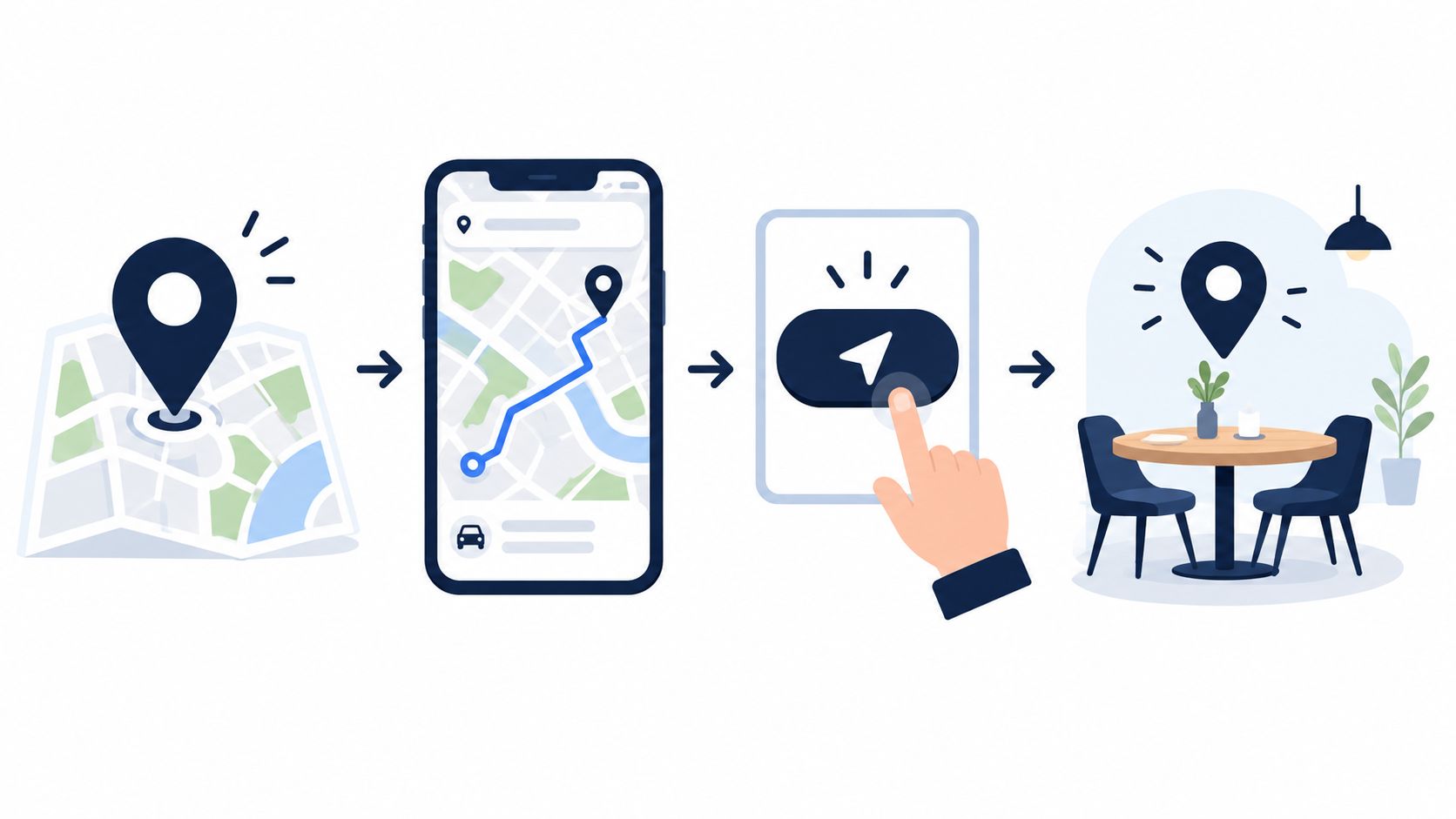
The useful path starts with a pin, not a restaurant list. Scan the map and identify an offer that sits close to your current position or along the trip you already need to make. Then check whether its direction works with your route before you spend time reading every detail.
<a id="follow-the-short-action-loop"></a>
Follow the short action loop
- Tap the POG: Open the nearby restaurant deal from the map and identify the venue, offer, and any visible timing information.
- Check route fit: Ask whether the restaurant is ahead, reasonably adjacent, or sending you in the wrong direction. A cheap meal that adds an awkward detour isn't a convenient deal.
- Tap to route: Start navigation only after you've confirmed the stop makes sense. If you're driving, make this choice while parked or before moving.
- Open the offer details: Use the next tap to review the redemption instructions, restrictions, and timing.
- Capture the deal: Save or open the offer in the way the platform provides, then keep the redemption screen ready for arrival.
A tight geographic filter matters because the offer has to remain actionable. The practical methodology described by MenuSifu's QSR marketing guidance recommends a zone that corresponds to roughly a four-to-five minute travel window. Its campaign benchmarks report that 36% of users who clicked an ad took a secondary action, 18% of those saved the coupon, and 3.6% of the secondary actions ended in coupon redemption. Those figures shouldn't be treated as a promise for every campaign, but they illustrate why the path from discovery to capture needs as little friction as possible.
<a id="adjust-the-flow-to-the-trip"></a>
Adjust the flow to the trip
A commuter should favor a venue ahead on the route, with easy access and a short pickup. A tourist can broaden the search after reaching a walkable district, then choose the offer closest to the next planned stop. During an errand run, the best result may be the restaurant beside the store you already need to visit, even if another offer looks more generous.
Avoid setting a large radius to make the map look busy. A broad zone can introduce stale, inconvenient, or low-relevance options. If nothing works, broaden the radius deliberately, then reassess the route rather than accepting the first pin.
The goal isn't to collect offers. It's to move from map pin to route to redemption before the opportunity stops fitting your trip.
<a id="match-the-right-deal-type-to-your-mission"></a>
Match the Right Deal Type to Your Mission
“Cheap food” is too vague to guide a fast decision. The useful question is, what kind of stop am I making? A daily special, BOGO offer, combo, off-peak discount, or smaller-portion price reduction solves a different problem.
The National Restaurant Association's off-premises research reports that more than 8 in 10 off-premises customers would use daily specials, value or combo meals, or BOGO offers if available nearby, and roughly 8 in 10 would use off-peak discounts. The same source points to a market where deal format matters, not just the existence of a promotion.
<a id="deal-type-by-trip-mission"></a>
Deal Type by Trip Mission
| Trip Mission | Best Deal Format | When to Use It | |---|---|---| | Fuel stop | Daily special or value meal | When you need a predictable, quick meal near the next part of the route | | Family errand | Combo meal or BOGO offer | When several people need food and shared value matters more than individual customization | | Tourist lunch | Daily special or off-peak discount | When you're exploring and can shift lunch slightly to avoid a crowded, expensive window | | Late-night snack | Smaller-portion, lower-price offer | When you want something light without paying for a full meal | | Commuter pickup | Route-adjacent special or value meal | When the restaurant is already near the commute and pickup speed matters | | Flexible local meal | Off-peak discount | When your schedule allows you to eat outside the busiest period |
For a fuel stop, a complicated BOGO condition can slow you down. For a family, that same structure may make sense if everyone can share or use the second item. A smaller portion works when appetite, budget, or timing makes a full combo unnecessary, while an off-peak offer is valuable only if you can arrive during its window.
A separate consumer summary reports that 32% of consumers are most motivated by price offers, while coupons and value menus each influence 29% of restaurant decisions. It also says 48% of employed respondents would visit a restaurant near or on the way to work more often if they received coupons. SalesFuel's summary of the Valassis Coupon Intelligence Study supports a simple commuter rule: don't search for the biggest-looking promotion, search for the format that removes the most friction from your stop.
For more location-focused discovery options, see the AIR.POG deal finder app guide, then filter by the mission you have.
<a id="timing-verification-and-safety-tips-that-save-time"></a>
Timing Verification and Safety Tips That Save Time
A nearby offer can still waste your time if the details are old, inconsistent, or impossible to redeem during your visit. Verify the day, time window, participating items, and redemption process before routing. If the menu or offer information conflicts across channels, treat that uncertainty as a cost.
That concern is practical, not theoretical. Popmenu's 2026 findings report that 27% of diners identified inconsistent menu information across channels as a reason not to choose a restaurant, while 54% cited raised menu prices or a lack of affordable meals or discounts as deal breakers. SevenRooms' U.S. data report also reports that 68% of U.S. consumers said they were cutting back on restaurant dining in 2026, with average weekly restaurant spending falling from $115 in June 2025 to about $90 in February 2026. The takeaway is not to chase every promotion. Choose offers you can verify and use.
<a id="a-simple-verification-routine"></a>
A simple verification routine
- Check the time window: Confirm that the offer will still be active when you arrive.
- Read the conditions: Look for purchase requirements, excluded items, and location limits.
- Compare the route: A discount isn't worth a detour that disrupts the trip.
- Keep the handoff ready: Open the offer before arrival, not while standing at the counter.
- Switch quickly: If the information looks stale, choose a clearer nearby option.
Timing also changes who is likely to switch restaurants. One summary reports that 54% of diners usually stick with the same restaurant, while 20% switch because of promotions or coupons and 12% switch to find the lowest price. Atomic Social's analysis of timely local deals suggests targeting high-intent moments such as lunch windows, commute corridors, and unfamiliar areas instead of assuming every nearby person wants a bargain.
Driving safety comes first. Set the map and route before moving, use a mounted phone with a clear view, and avoid reading offer conditions in traffic. The AIR.POG dash phone mount guide covers the kind of setup that supports larger, glanceable interaction. If the offer needs more than a quick tap, pull over.
Safety rule: Navigation can wait at a safe stopping point. No restaurant promotion is worth interacting with a phone while driving.
<a id="your-quick-action-plan-to-just-pog-it"></a>
Your Quick Action Plan to JUST POG IT
Nearby restaurant deals become useful when the search turns into a repeatable reflex rather than a browsing session. Start with the trip, not the discount. Decide whether you're looking for a commuter pickup, family meal, tourist lunch, fuel stop, or late-night snack, then let that mission determine the deal format.
Use this checklist:
- Center the map on your current position or selected city.
- Set a realistic radius that reflects how far you'll travel.
- Scan the nearby POGs and use POG REELS if you need time-sensitive options.
- Pick the offer that fits the route, not merely the largest apparent saving.
- Tap to route only after checking direction and access.
- Open and capture the offer before you arrive.
- Broaden the radius only when the current area has no practical match.
- Switch deal type when the mission changes, such as moving from a solo snack to a family stop.
If you're already driving, make the selection before departure or pull over. The progressive web app format makes a quick launch from the home screen practical, while the map keeps the decision anchored to where you are rather than where a generic list says a restaurant exists.
Try the process on your next ordinary errand. One clean stop, with no wasted detour and no frantic searching at the counter, is enough to make JUST POG IT a useful daily habit.
AIR.POG surfaces live local promotions on an interactive map and connects nearby discovery with direct routing and offer details. Visit AIR.POG before your next commute or errand, set a practical radius, and find a restaurant deal that fits the trip you're already making.
Spread the word — every share brings more POG'rs to the map. 🎯
Got a story or tip?